01
You work with the attorney, not an intake team
The person who takes your first call is the person who drafts your application and answers your office actions. Nothing is handed down a chain.
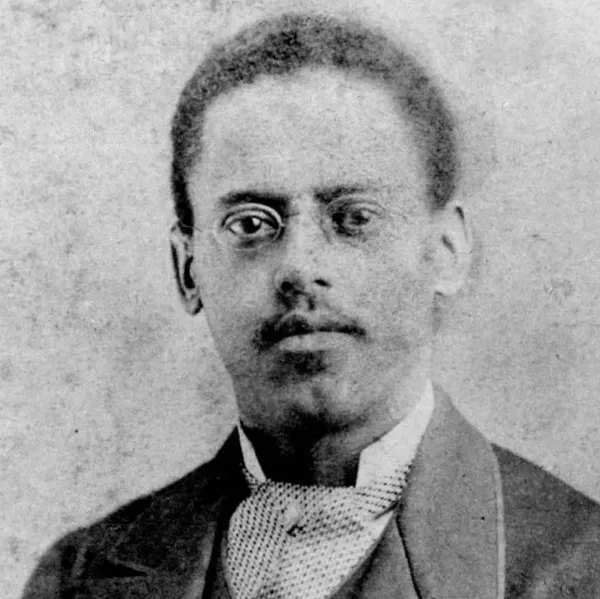
We are named for Lewis Howard Latimer, who drew patent figures for a living before he patented a better way to manufacture the filaments inside the lamp.
Drawings from expired US patents. Lit: US 247,097, Joseph V. Nichols and Lewis H. Latimer, Electric Lamp, granted 1881.
Latimer was born in 1848 in Chelsea, Massachusetts, to parents who had escaped slavery. He enlisted in the Union Navy as a teenager and afterward took a job as an office boy at a Boston patent law firm, where he taught himself mechanical drafting by watching the draftsmen work and practicing with instruments he bought secondhand.
He got good enough that the firm promoted him to head draftsman. Preparing patent drawings meant reading inventions closely enough to render them correctly, which is a form of technical literacy most attorneys never acquire. Latimer wrote in 1911 that he prepared the drawings for Alexander Graham Bell's telephone application. Historians have found no corroborating record, so the claim rests on his own account.
Latimer went to work for Hiram Maxim at the United States Electric Lighting Company, a competitor of Edison's. Early incandescent lamps burned out quickly and cost too much to manufacture, and the carbon filament inside them was the reason for both problems.
In 1882 Latimer received a patent for an improved process of manufacturing carbon filaments, building on the method used at Maxim's company. Cheaper, longer-lasting filaments helped make electric light practical to install and run. He later joined Edison's company and became one of the Edison Pioneers, the association of Edison's early collaborators, in which he was the only Black member.
Latimer worked as a Black engineer and inventor in nineteenth-century American industry, in rooms where nobody expected him and many preferred he not be there. He built a body of patented work anyway, and he wrote one of the first books on incandescent electric lighting while he was at it.
We took the name because Latimer did both halves of this job. He understood the machines, and he knew the patent system from the inside.
Both of our attorneys hold mechanical engineering degrees, so neither of us needs an invention translated before we can protect it.
The second is knowing the system from inside. Maurice Williams spent seventeen years examining applications at the USPTO. Latimer learned the patent process by drawing thousands of figures for it.
Bright ideas. Brilliant patents.
An idea has to get past prior art and an examiner before it protects anything, and the drafting decides how much of it gets through.
Filament Legal is a small firm on purpose.
01
The person who takes your first call is the person who drafts your application and answers your office actions. Nothing is handed down a chain.
02
A firm paid to file has an obvious incentive to recommend filing. We would rather lose the engagement than take money for a patent too narrow to be worth holding.
03
Prosecution runs for years and most of it is quiet. You will know where your matter stands without having to ask, and you will know what the next deadline is.
Most first calls go on explaining what examination actually involves. We would rather spend the time than have you learn it mid-prosecution.